Monday, 23 May 2011

Joanna (Lisa St.Aubin De Teran) 429


What a fantastic read Joanna turned out to be - it was a Virago that I knew nothing about before reading (which was probably why I ordered it online), and it was the next book out of my box. It's nice to be surprised by a book.

The novel is a tryptich of tales - the Joanna of the title, her mother Kitty, and her grandmother Florence, and their stories are all brought together at the end. Joanna spends most of her childhood attending convent schools and dealing with her mother who considers her to be an abomination (which is why she is sent away so often); unsurprisingly she rebels which seems to turn her mother even further against her. Finally, in what can only be described as a psychotic episode, her mother attacks her and she leaves home. Trying to find her place in the world is difficult, it is the war, and she becomes a nurse, marries, but her husband is called up and the relationship quickly breaks down. As we then follow the livesof Kitty and Florence, Joanna's story begins to make a bit more sense, but it is not until the very final chapter, when we return to Joanna, visiting her mother in an asylum that it all begins to make sense.

An absolutely gripping family drama.

It has quite an un-Virago like cover - almost a cross between a "green" edition, and a modern edition. The spine is green (except on my copy which is so badly faded that it is blue), but it has a little picture at the top of it.


*Edit* Interesting comment from Jane:

I could be wrong, but I think what happened with the cover was this - the book was a Virago original in the 1980s and became a VMC later, keeping the same cover. Does that make sense?

Thursday, 19 May 2011

Liana (Gellhorn)


The method of choosing the next VMC by which one comes out of the box of TBR first seems to be working (we are in the midst of moving house and everything is packed, but it a fairly organised fashion so I can sort of find things if not choose things), as I really enjoyed reading Liana by Martha Gellhorn, a book which is wonderfully reflected by the wistful looking girl on the cover of the Virago edition.

Liana, a young mixed-race girl is taken as a mistress and then married, by Marc, a wealthy Frenchman on a French Carribean island in 1940 (we are told that the island is cut off from the world by the war, but this doesn't seem particularly important). Marc renames her "Julie" and tries to make her into an appropriate wife, getting her to speak French, and finding a teacher so that she can learn to read a book. In some ways Marc seems very benevolent, but the more one learns about him, the more unpleasantly he comes across - the marriage comes with a contract that Liana's family can't visit her, he retains another mistress who he spends at least 3 evenings with a week. Liana's teacher Pierre provides a welcome escape, taking her on picnics and spending time with her for who she is.

It was really quite a different read to Gellhorn's other VMC, A stricken field. Of the two, I enjoyed, and would be more likely to recommend this one.

This has been published just once by Virago with an original green cover.

Wednesday, 18 May 2011

Lantana Lane (Dark) 212


Today I picked up Lantana Lane by Eleanor Dark, which was another of the four books that I was kidnly sent by Heather. I read The little company, Dark's only other VMC (although she wrote 10 novels) a little while ago and wrote about it here, but this one was quite different (the type was of a much more readable size for a start).

Almost anecdotal and a series of vignettes rather than a novel, this book introduces us to the members of the farming community at Lantana Lane. (Lantana by the way is an uncontrollable tropical weed that plagues the farmers).

It's difficult to write more about it; I loved the descriptions of the characters, such as Gwinny Bell:

"And when you see her working down in the pines, or pedding out her vast quantity of garments on the line, or striding along the Lane to visit one of the neighbours, you seem to hear Wagnerian music, and lo! - the scene dissolves. Fade out the serviceable working clothes , or the best frock of gay, floral rayon; fade out the felt slippers, or the patent leather shoes; fade out the battered, weekday hat, or the Sunday straw with its purple flowers, and its little pink veil. Fade in accomplished draperies which reveal the limbs they should be covering, and shining breastplates which proclaim the curves they guard; fade in gold sandals laced about the ankles; fade in a horned helmet over blond, wind-driven fair."

The characters just seemed to absolutely spring off the pages in this book.

It's just been published once with an original green cover. Do look out for it!

Tuesday, 17 May 2011

A garden of earthly delights (Oates)


I read my first Joyce Carol Oates, a little while ago (Expensive People) which was fascinating, not least because of its untypical (for a VMC) male teenager narrator. Shortly afterwards, Rachel at Booksnob reviewed a non VMC Oates book, and we got into a discussion about whether or not Oates was a "bleak" writer. Having only read the one novel by her, I ordered another from the library, A garden of earthly delights, which pleased me by arriving in a nice green edition.

It's one of Oates' early books and thus I'm not sure whether it is typical of the rest of her work. This book is a saga of the life of a woman named Clara, told through three novellas, each named after a man who was significant in her life: Carleton, her father, Lowry, her lover and Swan, her son. And yes, it is pretty bleak. Clara is born to migrant workers in the midst of the depression; we see her as she grows up, and then as she falls in love with Lowry, falling pregnant. But she ends up marrying another man, and the remainder of the book deals with her relationship with her husband and her sons.

This one has just been published once by Virago with a green spine but otherwise "modern" cover. One more Oates features on the VMC list - Solstice - and I shall certainly be intrigued to give it a go. And I found this page about Oates on the internet whilst writing this post which has some interesting articles.

Monday, 16 May 2011

Wreath of Roses (Taylor)


Another VMC re-issue, out today - Wreath of Roses by Elizabeth Taylor. This features an introduction by the masterful Helen Dunmore. Although I have to say that I'm underwhelmed by the covers that Virago have reissued Elizabeth Taylor in, I am very happy that she has been brought back into print as I hope that it will enable her to find a whole cohort more of readers (see the previous edition's cover below - far more appealing!). Thanks to Virago for sending me a copy.


I've still not blogged about Elizabeth Taylor, as I read most of her books before this blog - if anyone fancies doing a guest review, then let me know!

Thursday, 12 May 2011

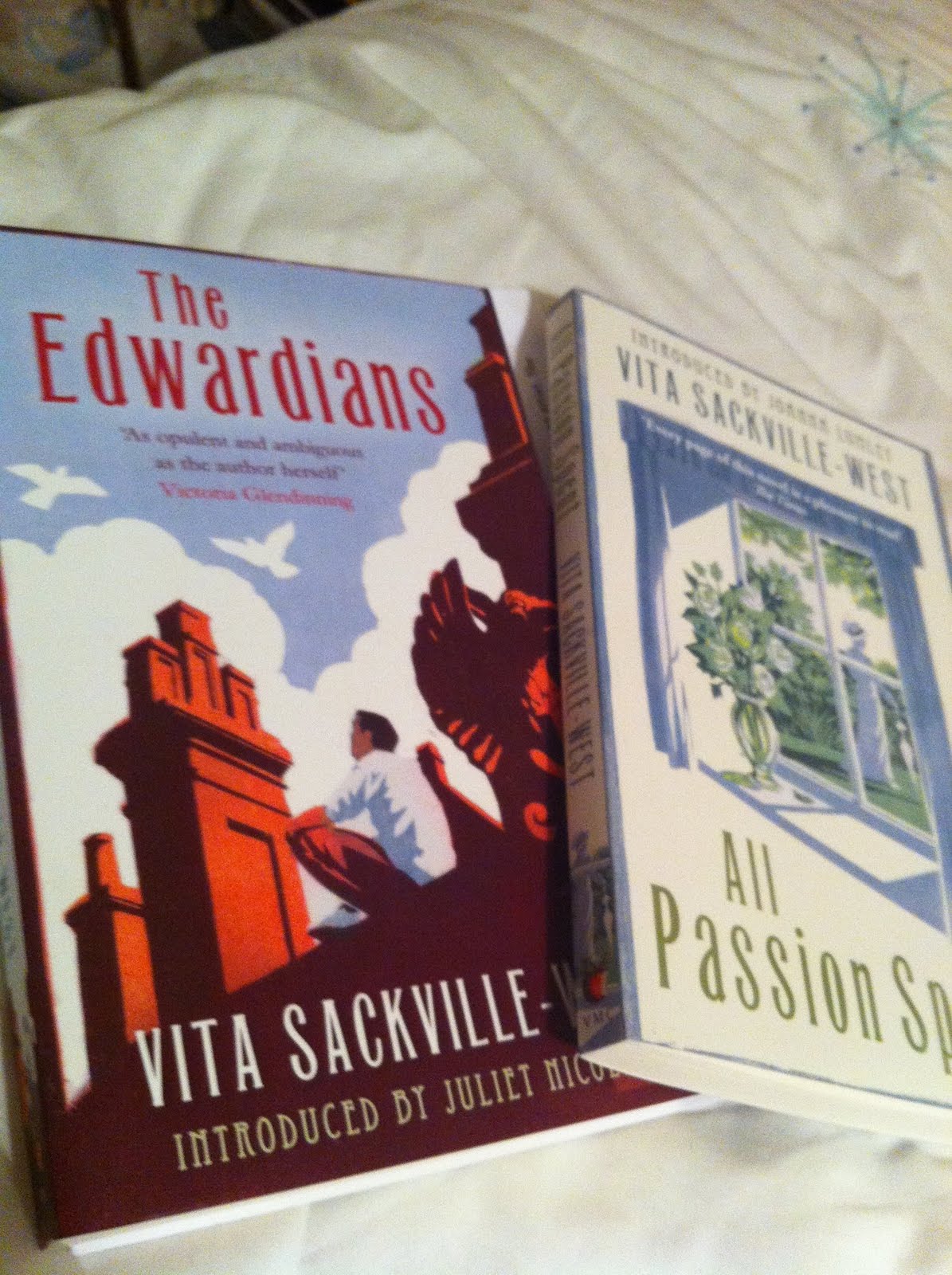
New Vita Sackville-West editions


Aren't these really rather lovely? I was sent copies of the latest Virago Modern Classics re-releases at the end of April and they're out in the UK today!

I am a big fan of Vita Sackville-West (or as one of my friends refers to her - Ryvita Snackville-West!), who I only discovered as part of my VMC journey, and am really happy that there will be such attractive editions of her works available in the shops as this will hopefully encourage more people to read them.

All Passion Spent
is introduced by Joanna Lumley and The Edwardians is introduced by the historian Juliet Nicholson. Having loved both of these books, I am looking forward to reading the introductions and maybe rereading them, particularly as this summer I will finally get to visit both Knole and Sissinghurst on the August Bank Holiday (as part of a trip to do a sea swim at Margate).

Wednesday, 11 May 2011

Dessa Rose (Williams) 447


I didn't know anything at all about Dessa Rose, which I think was why I probably ordered it from Awesome books a few months ago - it was on the VMC list and I had never heard of it. I wondered if it was an undiscovered gem or something which just didn't get talked about because it is not very interesting. I think the book falls into the first category, although I didn't find it very easy to read. I've since seen a number of reviews which compared this book to some of Toni Morrison's works, such as Beloved, and I would agree with that - I mention it here because I know that a number of readers of this blog are fans of hers.

The novel is apparently inspired by two real events as the author's note explains:

A pregnant black woman helped to lead an uprising on a coffle (a group of slaves chained together and herded, usually to market) in 1829 in Kentucky. Caught and convicted, she was sentenced to death; her hanging, however, was delayed until after the birth of her baby. In North Carolina in 1830, a white woman living on an isolated farm was reported to have given sanctuary to runaway slaves. I read of the first incident in Angela Davis' seminal essay, "Reflections on the Black Woman's Role in the Community of Slaves" (The Black Scholar, December 1971). In Tracking Davis to her source in Herbert Aptheker's American Negro Slave Revolts (New York, 1947), I discovered the second incident. How sad, I thought then, that these two women never met.

And this novel brings them together. It opens with Dessa, the pregnant slave who is waiting for her baby to be born so that she can be hung. I found one scene where she and other slaves join in singing negro spirituals together intensely moving; the very real sorrow at being trapped into this situation. In the second part of the book Dessa escapes, with the help of some other slaves, to Miss Rufel's plantation. Miss Rufel is a white woman, who harbours escaped slaves, but not wholly out of kindness. She has been left by her husband, and most of her slaves left too; she can only stay on the plantation with the help of slaves, and they stay because they have relative freedom.

It's a fascinating read, although the way it is told is not straightforward, mainly because Williams goes very far to try and subvert the usual way in which slaves, black people, white people, women are usually depicted.

It's just been published once by Virago in a green-spine only form/modern green edition.